

Author:
Chris Peters
Role:
Managing Director
Publish Date:
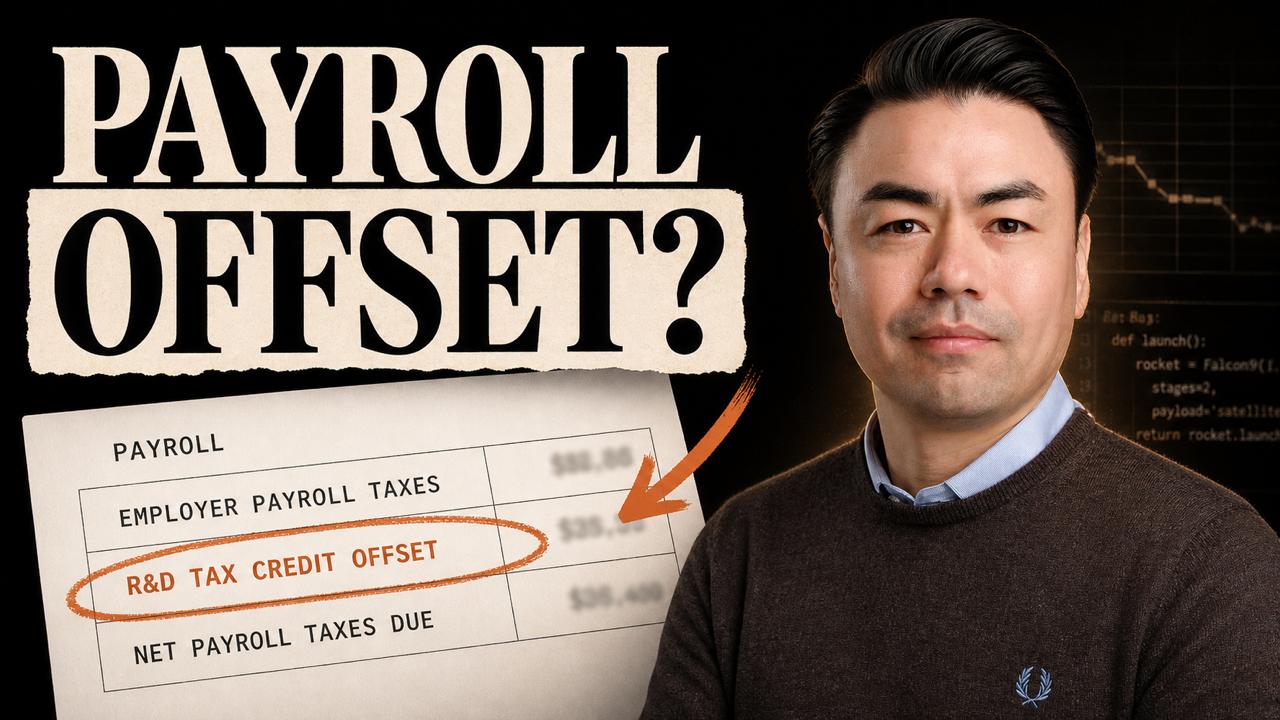
For many early-stage founders, the Research and Development (R&D) tax credit is often dismissed as a benefit reserved for profitable, established corporations. However, a common misconception exists that if a company has no income tax liability, it cannot qualify for the credit. In reality, the federal R&D tax credit offers a powerful mechanism for pre-revenue startups to offset payroll taxes, directly reducing burn and extending their runway without requiring equity dilution.
The Payroll Tax Offset: The 5-5-5 Rule
While the R&D credit has existed since the 1980s, the IRS introduced a significant expansion in the mid-2010s to support innovative companies that were not yet profitable. Today, eligible startups can utilize up to $500,000 of their R&D tax credit each year to offset the 7.65% employer portion of social security and Medicare taxes.
To qualify for this payroll offset, a company must generally adhere to what is known as the 5-5-5 Rule:
First 5 Years: The company must be in its initial five-year phase of operations.
$5 Million Cap: The company must have less than $5 million in gross receipts (sales) for the taxable year.
5-Year Limit: A company can only elect to utilize the payroll tax offset for a total of five years.
For companies that do not meet these criteria or have no payroll tax to offset, the credit remains a valuable tax attribute that can be carried forward for up to 20 years at the federal level to offset future income taxes as the company scales.
Qualifying for the Credit: The Four-Part Test
Eligibility is not determined by a company’s industry title but rather by the specific technical challenges the team is working to overcome. The IRS applies a four-part test to determine if an activity qualifies:
Permitted Purpose: The work must involve creating a new product or improving the quality, reliability, or capability of an existing one.
Hard Science: The research must be grounded in the "hard sciences," such as computer science or engineering.
Elimination of Uncertainty: There must be a technical uncertainty at the outset regarding the design or methodology of the solution.
Process of Experimentation: The team must engage in a systematic process to evaluate alternatives and overcome those technical challenges.
For software platforms, the IRS suggests looking at subcomponents rather than the platform as a whole. For instance, developing a specific new functionality that requires solving technical hurdles would be the focus of the claim.
The Documentation Standard: Moving Beyond AI Platforms
As the IRS moves toward requiring more data upfront—with mandatory detailed reporting coming in tax year 2026—documentation has become the primary point of failure for many claims. While automated AI platforms may offer a quick way to generate a credit number, they often fail to provide the "nexus" required for audit defense: a clear connection from the individual's daily activities to specific technical projects.
The good news for tech founders is that the necessary "engineering-grade" artifacts often already exist within the company's current workflow. Tools such as Jira, GitHub, and Confluence serve as repositories of the development process. By simply tagging projects and maintaining clean records of technical sprints, companies can substantiate their claims without creating significant additional work for their engineering teams.
Strategic Implementation
Claiming the credit requires a coordinated effort between your technical leadership and your tax providers. The process involves making a specific election on Form 6765 and utilizing Form 8974 as the bridge to your payroll provider.
Because many generalist CPAs do not specialize in the nuances of R&D documentation standards, it is critical for founders to verify that their capture process is structured and predictable. Properly executed, the R&D tax credit can provide between $50,000 and $197,000 in annual offsets for a typical team of eight engineers, making it a cornerstone of a startup’s capital strategy.
