The easiest way to understand the R&D payroll tax offset is to see how it works in different startup situations. The biggest variable isn’t simply how much a company spends on engineering, it is which expenses actually qualify, how much credit the company generates, and how much employer payroll tax it has available to offset.
Hey Companys look every startup is different in his own way even they are operating in the same industry , even they are working over the same thing , even they have the same number of engineers or even they have souce the raw material from the same supplier in same quantity even than also they are different because the process , experimentation they follow possible be a different so to better understand the situation its viable to look into different scenarios . It gives you a rough picture of it .
Below are three startup scenarios that show how the numbers can change.
Example 1: Pre-Revenue AI Startup
Imagine an early-stage AI startup with four U.S.-based machine-learning engineers. The team spends most of its time developing proprietary infrastructure and testing new technical approaches.
Annual expenses:
- U.S. engineering wages: $600,000
- Qualifying cloud staging/testing costs: $50,000
- Total QREs: $650,000
- Illustrative R&D credit at 10%: $65,000
The company’s employer Social Security tax on the $600,000 payroll would be approximately $37,200.
If the startup qualifies for the payroll tax election, it could use the available credit to offset that employer payroll tax liability.
That means approximately $3,100 per month in employer Social Security tax could be retained rather than paid out.
The important lesson is that the startup doesn’t need a $500,000 credit to benefit from the payroll offset. A much smaller credit can still meaningfully extend the runway.
Example 2: High-Growth SaaS Startup
Now consider a B2B SaaS company generating revenue but still operating at a loss because it is aggressively reinvesting in product development.
Suppose it has:
- U.S. engineering wages: $2,500,000
- U.S. contractor payments: $300,000
- Eligible contractor portion at 65%: $195,000
- Total illustrative QREs: $2,695,000
- Illustrative R&D credit at 10%: $269,500
The company’s employer Social Security tax on $2.5 million of wages would be approximately $155,000.
In this simplified example, the calculated credit exceeds the company’s annual employer Social Security liability.
The result is important: the credit calculation and the amount you can actually use against payroll taxes aren’t necessarily the same number.
A startup can generate a substantial R&D credit while having a smaller payroll tax liability available for the offset. The remaining credit must then be evaluated under the applicable carryforward and income-tax-credit rules.
That is why founders should never equate “credit generated” with “cash recovered.”
Example 3: Hardware Startup With International Contractors
Consider an IoT startup developing a smart-home device.
Its development team includes U.S. engineers and contractors located overseas.
Suppose the company has:
- U.S. engineering wages: $250,000
- International contractor payments: $150,000
- Qualifying U.S. prototype materials: $30,000
- Illustrative QREs before exclusions: $280,000
- Illustrative R&D credit at 10%: $28,000
The international contractor expense is the critical issue.
Research performed outside the United States generally does not qualify for the federal R&D credit. So the company cannot simply treat its global engineering spend as one pool of qualifying research expenses.
The domestic wages and otherwise qualifying domestic research costs still need to be evaluated independently.
With $250,000 of U.S. engineering wages, the employer Social Security tax would be approximately $15,500.
The startup could therefore potentially offset that liability with its available payroll tax credit, subject to the applicable rules.
The Lesson From This Scenario
This is where we learned an expensive lesson.
We initially looked at our global engineering budget and assumed that the amount spent on development would translate directly into our federal R&D credit. A large portion of our backend development was performed by contractors in Europe, and we treated that spending as though it had the same tax treatment as our domestic engineering payroll.
It didn’t.
The mistake wasn’t spending money internationally. The mistake was failing to separate our U.S. qualifying research expenses from research performed outside the United States when we calculated our potential credit.
That distinction dramatically changed our expected recovery.
What These Examples Actually Show
These scenarios reveal three important principles:
1. Engineering spend isn’t automatically creditable.
The location, nature, and purpose of the research matter.
2. Your R&D credit isn’t the same as your cash recovery.
A company may generate a $65,000 credit but have only $37,200 of employer Social Security tax available to offset in the example above.
3. Global development requires careful expense separation.
International research cannot simply be combined with domestic research when calculating the federal credit.
For founders, the right question isn’t “How much did we spend on engineering?”
It’s:
“How much of our engineering spend represents qualifying U.S. research, what credit does that generate, and how much of that credit can we actually use?”
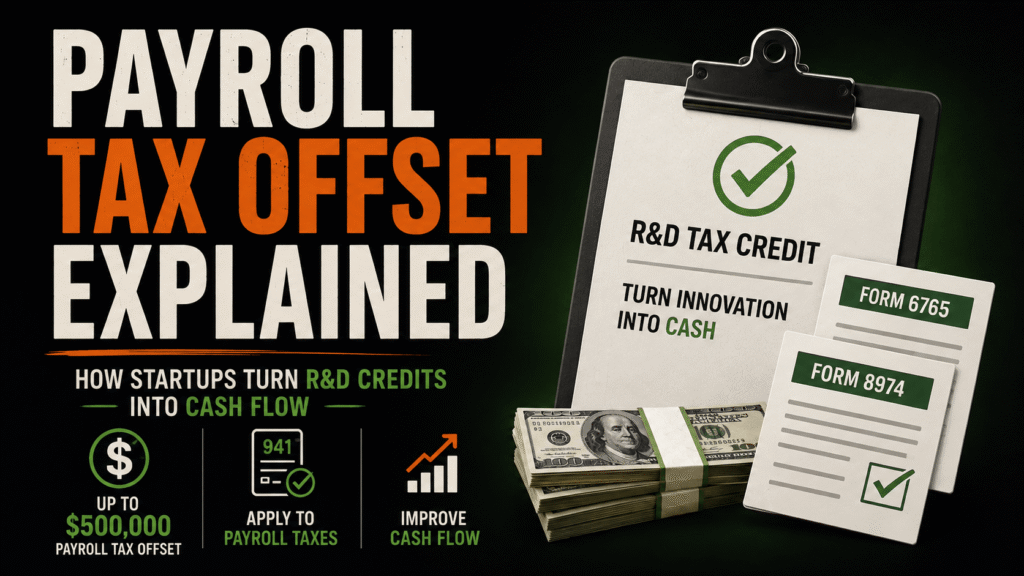
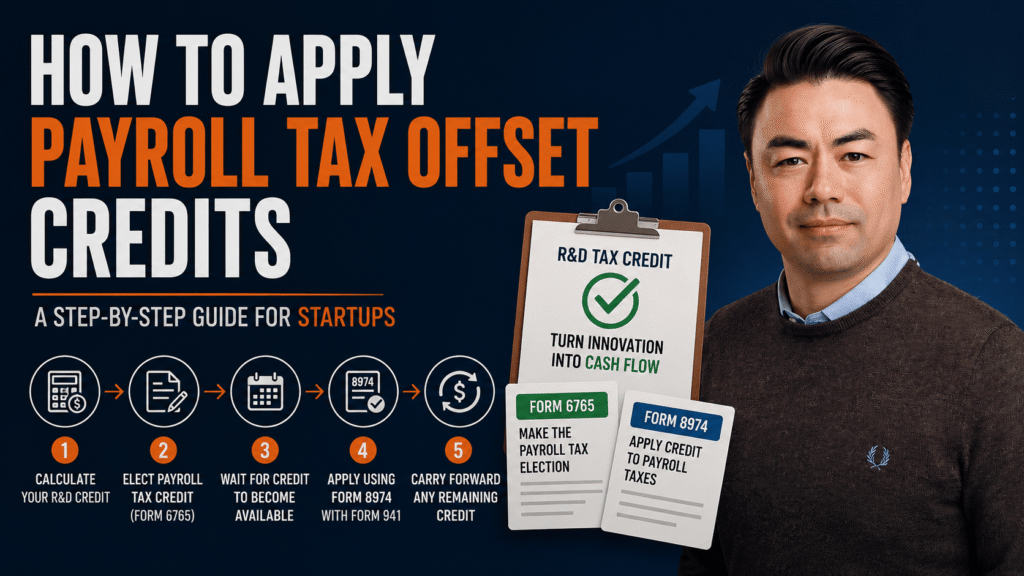
If you haven’t already, review Payroll Tax Offset Explained to understand eligibility and How To Apply Payroll Offset Credits for the filing mechanics.