
For an early-stage startup, R&D tax credit can be very valuable even when the company has little or no income tax liability. The R&D payroll tax offset allows an eligible small business to apply up to $500,000 of its federal R&D credit against eligible employer payroll taxes, turning a tax incentive into a practical cash-flow tool. This is the biggest opportunity that most of the founders miss because they think the R & D tax credit thing is only applicable for industries where there are some lab experiments . This is a complete myth that my team and I are trying to break down in the business world and help them claim R & D tax credit .
That distinction matters. A startup does not necessarily have to wait until it becomes profitable to benefit from its qualifying research activities.
What Is the R&D Payroll Tax Offset?
The payroll tax offset is an election under the federal R&D tax credit rules that lets a qualified small business use a portion of its research credit against its employer payroll tax liability.
For tax years beginning after December 31, 2022, the maximum election is $500,000 per year. The credit is applied first against the employer share of Social Security tax, with remaining amounts able to reduce the employer share of Medicare tax under the current rules.
For a startup burning cash on engineers, developers, and other qualifying research activities, reducing payroll tax liability can directly preserve working capital. I personally believe payroll offset is one thing that helps a lot of founder and solve their cash crunch for some point of time so that can focus on innovating something new that the world has not seen before .
Who Can Use the Payroll Tax Offset?
Not every company with an R&D credit qualifies for the payroll tax election.
A qualified small business generally must meet two key gross-receipts requirements:
- Have less than $5 million in gross receipts for the tax year.
- Have had no gross receipts for any tax year before the five-tax-year period ending with the current tax year.
The rules are more technical than simply asking whether a startup is “pre-revenue.” Gross receipts must be evaluated under the applicable tax rules, and aggregation rules can matter for companies with related entities.
That is a distinction founders should check before building a payroll-offset strategy around the credit.
How Does the Offset Actually Work?
The process has two separate stages.
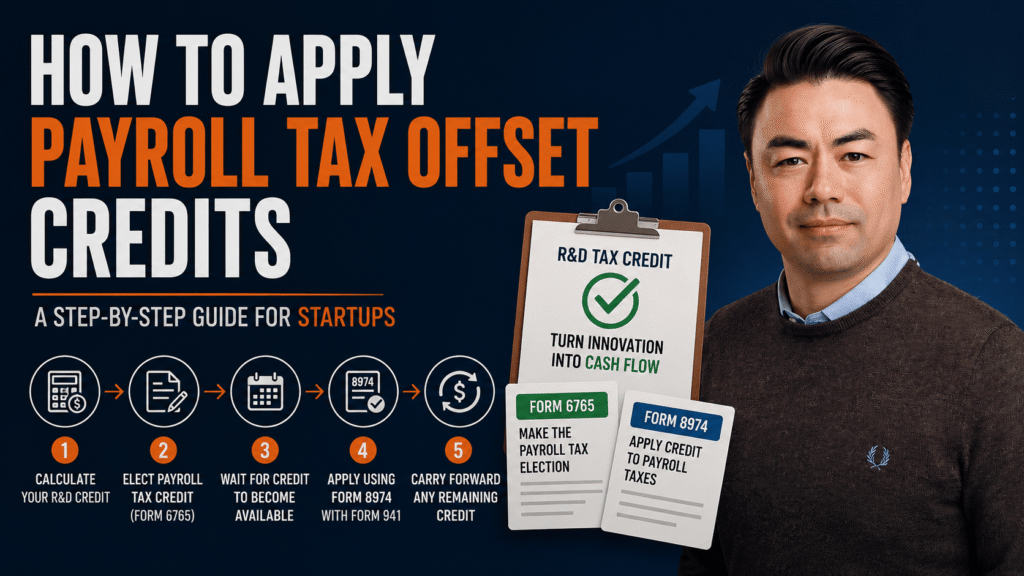
1. Elect the Payroll Tax Credit
The company first calculates its R&D credit and makes the payroll tax credit election on IRS Form 6765 with its timely filed original income tax return, including extensions. The election must be made by the return’s due date.
Simply calculating the R&D credit does not automatically put money back into your payroll account.
2. Apply It Through Payroll Filings
After the income tax return containing the election is filed, the company claims the payroll tax credit beginning with the first calendar quarter that begins after that filing.
The company uses Form 8974 with its applicable employment tax return, such as Form 941, to determine the amount available for that quarter. Any excess credit can carry forward to subsequent quarters.
This timing is one of the easiest parts of the process to overlook and one of the most important for a startup managing a tight runway.
A Simple Startup Example
Imagine a software startup generates a $100,000 R&D tax credit and qualifies for the payroll tax election.
If its employer payroll tax liability is sufficient, that $100,000 can be used to reduce eligible federal payroll taxes rather than sitting unused because the company has little or no income tax liability.
The benefit isn’t additional revenue. It is cash the company doesn’t have to send out for eligible payroll tax obligations.
That distinction can matter when a startup is deciding whether it has another month or quarter of runway.
The Lesson Founders Often Miss
We learned this the hard way: being pre-revenue isn’t the same thing as automatically qualifying for the payroll tax offset.
Early-stage companies can spend months focusing on engineering payroll and product development while overlooking the gross-receipts history that determines whether the payroll election is available. The mistake is treating the offset as a simple “startup benefit” rather than a tax election with specific eligibility and filing mechanics.
The same applies after qualification. Filing Form 6765 is only part of the process. The credit still has to move through the employment tax system using Form 8974.
I believe most of the startup misunderstood and misjudge the value of R&D Tax credit that it brings on table and it simply happen because they misunderstood the value
If you’re evaluating the R&D credit, start with eligibility, then calculate the credit, and only then build the payroll-offset strategy.
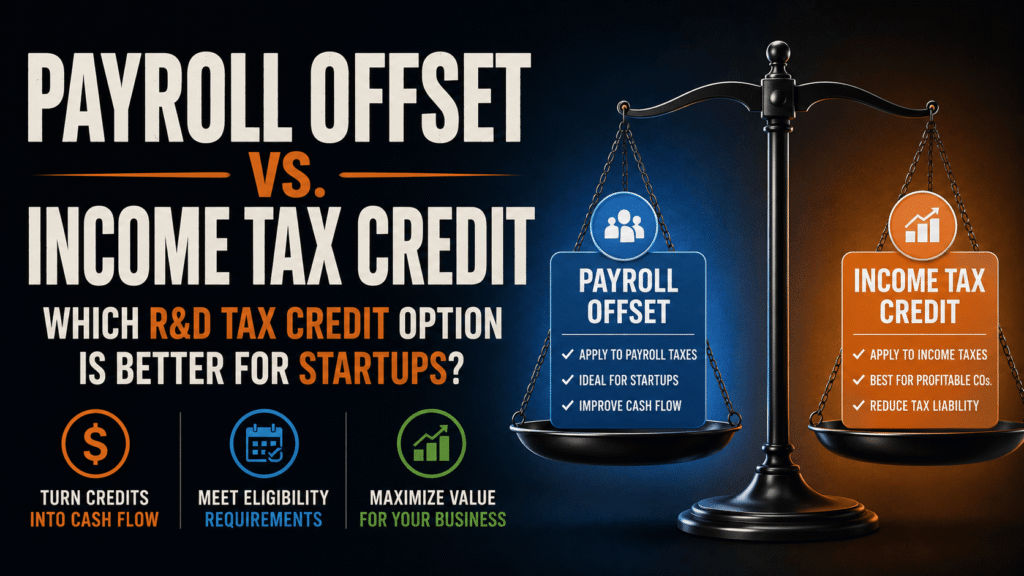
For a deeper explanation of the underlying incentive, see What Is the R&D Tax Credit? and How The R&D Tax Credit Works. Once you’ve established that your activities qualify, the next step is understanding whether a payroll tax offset or income tax credit produces the better result for your startup.
[…] you haven’t already, start with Payroll Tax Offset Explained to understand the eligibility requirements and mechanics. Then review How To Apply Payroll Offset […]
[…] you haven’t already, review Payroll Tax Offset Explained to understand eligibility and How To Apply Payroll Offset Credits for the filing […]
[…] guide to the Payroll Tax Offset Explained covers the mechanics in more […]
Comments are closed.