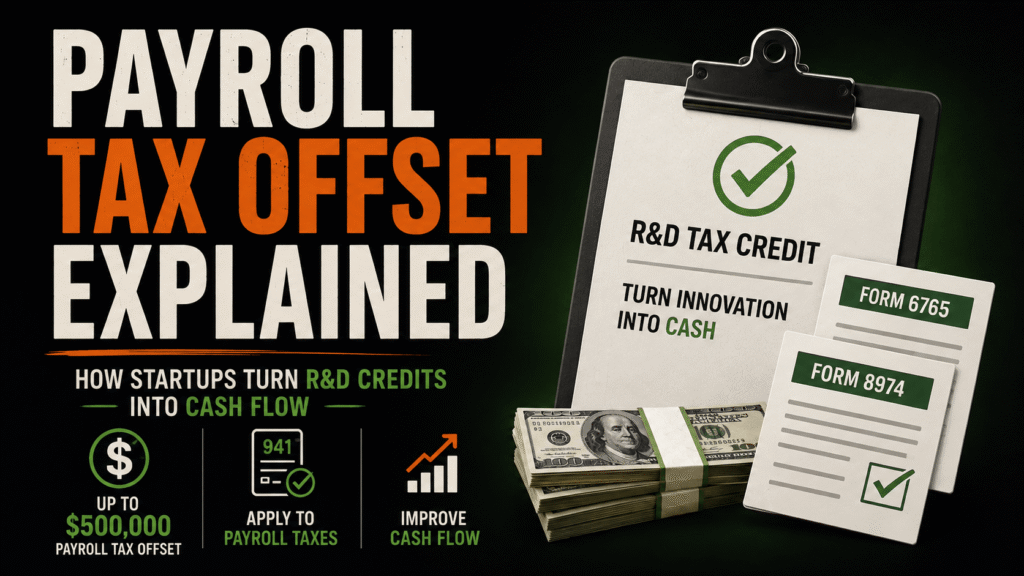
For many startups, the federal R&D tax credit can recover a meaningful portion of domestic product-development spending but the actual cash benefit depends on qualified expenses, the credit calculation, and whether the company can use the payroll tax offset.
A useful starting point is to think in terms of the qualified research expense (QRE) base, rather than simply applying a percentage to total engineering spend. A startup that spends heavily on U.S. engineering can potentially turn part of that investment into non-dilutive cash flow.
The Real Question Is: How Much of Your Spend Qualifies?
The biggest mistake founders make is assuming that every product-development dollar belongs in the credit calculation.
For software and technology companies, the primary expense categories can include:
- U.S. employee wages attributable to qualified research
- Qualified U.S. contract research, generally subject to the 65% limitation
- Certain qualifying supplies and testing costs
- Certain cloud and computing costs directly connected to qualifying research
That means a company spending $1 million on engineering does not automatically have $1 million of QREs.
The first step is determining which projects actually satisfy the IRS requirements and then connecting the appropriate expenses to those activities.
If you’re still evaluating what counts as qualifying work, our guide on What Qualifies For The R&D Tax Credit? is a useful starting point.
A Simple Startup Recovery Example
Consider a SaaS startup with:
- $1,200,000 in U.S. engineering wages
- $150,000 in qualifying domestic contractor expenses
- $50,000 in qualifying development and testing costs
The potential QRE base could look like this:
| Expense | Annual Spend | Potential QRE Treatment |
| U.S. engineering wages | $1,200,000 | Based on qualifying R&D activity |
| Domestic contract research | $150,000 | Generally 65% = $97,500 |
| Qualifying testing costs | $50,000 | Subject to eligibility |
| Potential QRE base | Up to $1,347,500 |
The actual federal credit would then depend on the company’s applicable calculation method and facts. A 7%–10% recovery range can be useful as a rough planning benchmark, but it should not be treated as a guaranteed credit rate.
The important point is that the value can become significant even for a relatively small engineering team.
The Payroll Tax Offset Can Change the Cash-Flow Impact
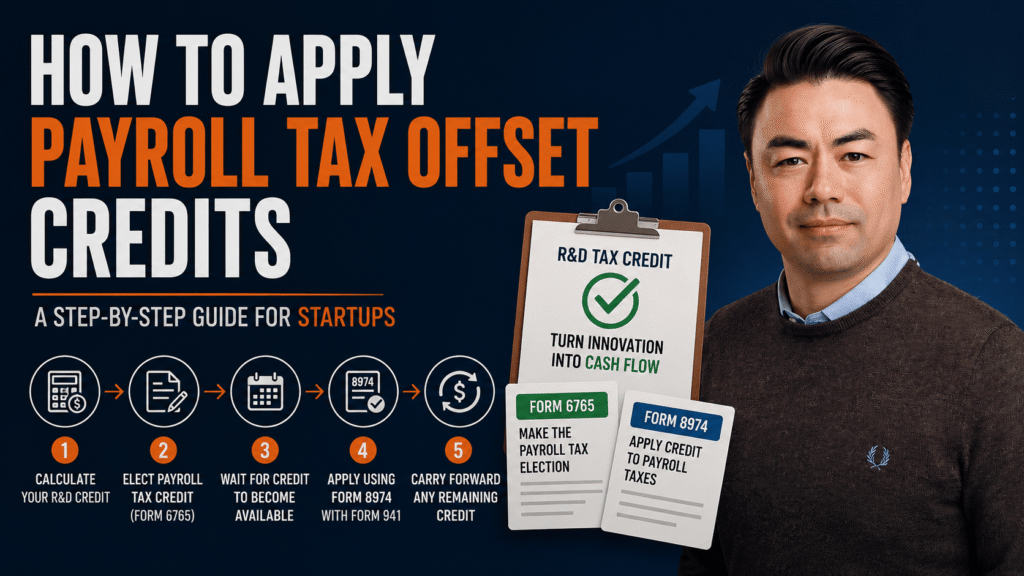
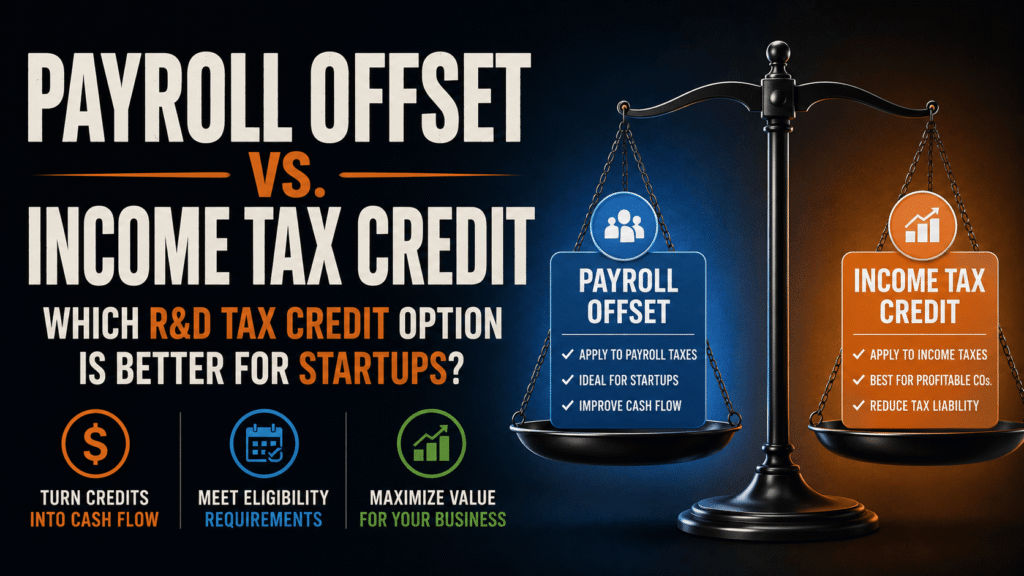
For an eligible small business, the R&D credit may be elected for use against certain employer payroll taxes rather than waiting for sufficient income tax liability.
That distinction matters enormously to a startup.
A profitable company may primarily view the credit as an income-tax benefit. A pre-revenue or unprofitable startup may instead care about how quickly the credit can reduce its cash payroll burden.
The payroll tax offset is subject to specific eligibility requirements and statutory limits, so founders should verify those requirements before building the benefit into their runway model.
Our guide to the Payroll Tax Offset Explained covers the mechanics in more detail.
Don’t Ignore Founder and Technical Leadership Time
One commonly overlooked area is qualified work performed by technical leadership.
A CTO may spend time evaluating architectures, directing technical experimentation, reviewing prototypes, or helping engineers overcome technical uncertainty. Those activities should not automatically be treated as ordinary management simply because the person is an executive.
But the opposite is also true: you shouldn’t automatically claim an executive’s entire salary.
The key is documenting the actual qualifying activity and the portion of time attributable to it.
That is where many startups understate their QREs.
The Hidden Variable Is Documentation
Two startups with identical engineering payroll can end up with very different defensible credit calculations.
Why?
Because the IRS isn’t simply asking, “How much did you spend on developers?”
The more important questions are:
- What technical uncertainty were they trying to resolve?
- What experiments or alternatives did they evaluate?
- Which employees worked on the qualifying activities?
- How much of their time was attributable to that work?
- What evidence supports the allocation?
Your Git commits, Jira tickets, architecture documents, test results, and other engineering records can help establish that connection.
We’ve covered this issue in R&D Qualification Checklist, particularly the importance of connecting technical work to the expenses being claimed.
Don’t Build Your Runway Around an Estimated Credit
The R&D tax credit can improve startup cash flow, but founders should treat an estimate as potential recovery not guaranteed cash.
A better approach is:
Identify qualifying projects → calculate defensible QREs → determine the credit → verify payroll-offset eligibility → model the actual cash-flow impact.
That process may produce a smaller number than an aggressive estimate. But a defensible credit is far more valuable than a large number that cannot survive scrutiny.
For a startup, the goal isn’t simply to maximize the headline credit.
It’s to recover as much legitimate value as possible and know that the number you’re putting into your runway model is one you can defend.