
Several startups qualify for the Federal R&D Tax Credit but fail to claim it because of the simple reason that they found documentation gaps only after tax season begins. The best way to avoid this type of silly mistake is to review your projects against a standard structured qualification checklist before filing for claim. It Majorly improves the chances of claim
If you are someone who is new to the credit world , start with our What Is The R&D Tax Credit? guide to understand the fundamentals. Then review The Four Part IRS Test Explained before using this Free checklist that I have created to evaluate your projects.
Why Every Startup Needs An R&D Qualification Checklist
A qualification checklist helps you identify eligible activities, organize documentation, and reduce audit risk before filing your claim. Waiting until year-end almost always leads to missing expenses or incomplete records.
We’ve seen founders spend months building innovative products only to discover they cannot support their claim because engineering records, payroll allocations, and project documentation were never organized properly.
At R&D Tax Advisors, we use our Qualification Confidence Framework, which reviews technical activities, financial records, and supporting evidence simultaneously instead of treating them as separate tasks.
R&D Qualification Checklist
1. Does Your Project Create Or Improve A Business Component?
Your work should improve the functionality, performance, reliability, or quality of software, products, manufacturing processes, or internal systems. Cosmetic changes alone generally do not qualify.
Examples include:
- Developing a SaaS platform
- Building an AI application
- Creating manufacturing automation
- Improving engineering processes
- Designing new hardware
A startup developing an AI-powered logistics platform qualifies because it is creating a new software product with measurable technical objectives.
Our Business Component Mapping System ensures every qualifying project is linked directly to its commercial purpose before documentation begins.
2. Did You Face Technical Uncertainty?
At the beginning of the project, your team should not know exactly how to achieve the desired technical outcome.
Technical uncertainty may involve:
- System architecture
- Performance optimization
- Scalability
- Database design
- Security implementation
- Manufacturing tolerances
Many founders mistakenly believe solving difficult engineering problems is simply “part of the job.” Under Internal Revenue Code Section 41, those uncertainties are often exactly what creates eligibility.
We document these uncertainties using our Technical Challenge Tracker, making them easier to defend later.
3. Did Your Team Experiment With Different Solutions?
Qualified projects involve systematic testing rather than implementing the first available solution.
Evidence may include:
- Multiple software architectures
- Prototype iterations
- Performance benchmarking
- Load testing
- Algorithm comparisons
- Engineering simulations
For example, an AI startup comparing three different machine learning models before selecting the final architecture demonstrates a clear process of experimentation.
Our Experiment Evidence Matrix connects every engineering decision to documented testing activities.
4. Was The Work Based On Engineering Or Computer Science?
Qualified activities rely on technical disciplines such as engineering, computer science, physics, chemistry, or biology.
Examples include:
- Software development
- Artificial intelligence
- Robotics
- Semiconductor design
- Manufacturing engineering
- Biotech development
Marketing campaigns, graphic design, customer research, and sales activities generally do not qualify.
Our Technology Qualification Framework separates technical work from ordinary business operations.
5. Are Your Qualified Research Expenses Properly Tracked?
Even if your project qualifies, you still need to identify the expenses connected to that work.
Typical Qualified Research Expenses (QREs) include:
- W-2 engineering wages
- Supervisory wages
- Technical support wages
- Prototype supplies
- Cloud computing used during development
- Eligible domestic contractor costs
Many software startups overlook cloud infrastructure costs used exclusively for testing and development environments.
Our QRE Capture System reviews every potential expense category before calculations begin.
6. Do You Have Documentation To Support The Claim?
Documentation often determines whether a claim survives an IRS review.
Useful records include:
- Jira tickets
- Git commits
- Design documents
- Engineering meeting notes
- Testing reports
- Payroll records
- General ledger details
- Contractor invoices
Waiting until tax season to recreate this information usually results in incomplete documentation.
Our Documentation Defense Framework organizes technical and financial evidence throughout the year instead of after development is complete.
What Most Qualification Guides Completely Ignore
Many founders focus only on technical qualification while overlooking jurisdiction and entity structure. That mistake can significantly reduce or even eliminate an otherwise valid claim.
We have learned this lesson after watching a startup rapidly expanding and organising engineering wages, cloud expenses, and contractor invoices into one global reporting pool. Their technical work clearly qualified, but the challenge is that documentation did not distinguish between U.S. operations and international entities.
When the company prepared its claim, it discovered that expenses associated with foreign activities could not be treated the same way as domestic qualified research. Payroll records, general ledger details, and project documentation were available, but they were not mapped to the correct U.S. business entities responsible for the qualified research. This Single Challenge dramatically reduced their chances of the claim.
The takeaway is simple . Your documentation should match the jurisdiction where the credit is being claimed. Technical qualification alone is not enough.
This is exactly why our Jurisdiction Alignment Framework reviews organizational structure, project ownership, payroll records, and technical documentation together before any calculations begin.
Final R&D Qualification Checklist
Before claiming the Federal Research and Development Tax Credit, confirm that you can answer yes to these questions:
- Is the project creating or improving a product, software, or process?
- Did the work involve technical uncertainty?
- Was there a documented process of experimentation?
- Was the work based on engineering or computer science?
- Were qualified research expenses tracked correctly?
- Do you have documentation supporting the work?
- Were the activities performed in the United States?
- Are your records aligned with the correct legal entity and tax jurisdiction?
The more confidently you can answer these questions, the stronger your claim is likely to be.
Continue Learning About The R&D Tax Credit
After completing this checklist, continue with these guides:
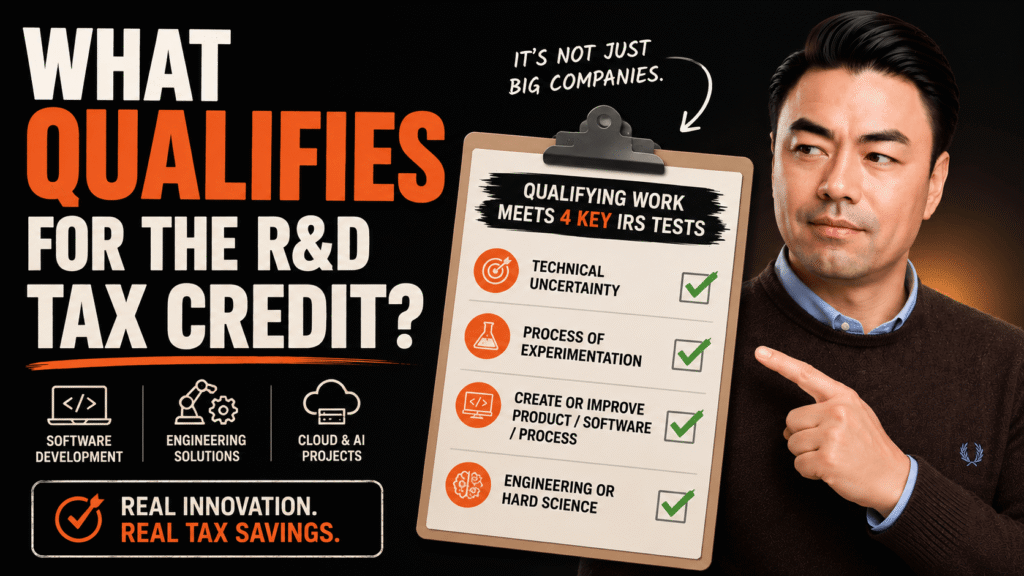
- What Qualifies For The R&D Tax Credit?
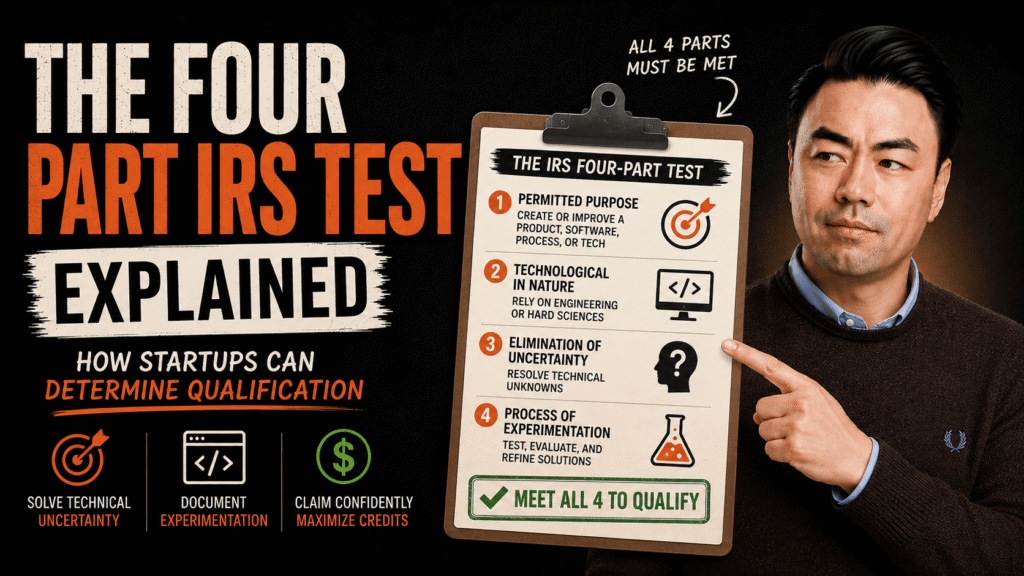
- The Four Part IRS Test Explained
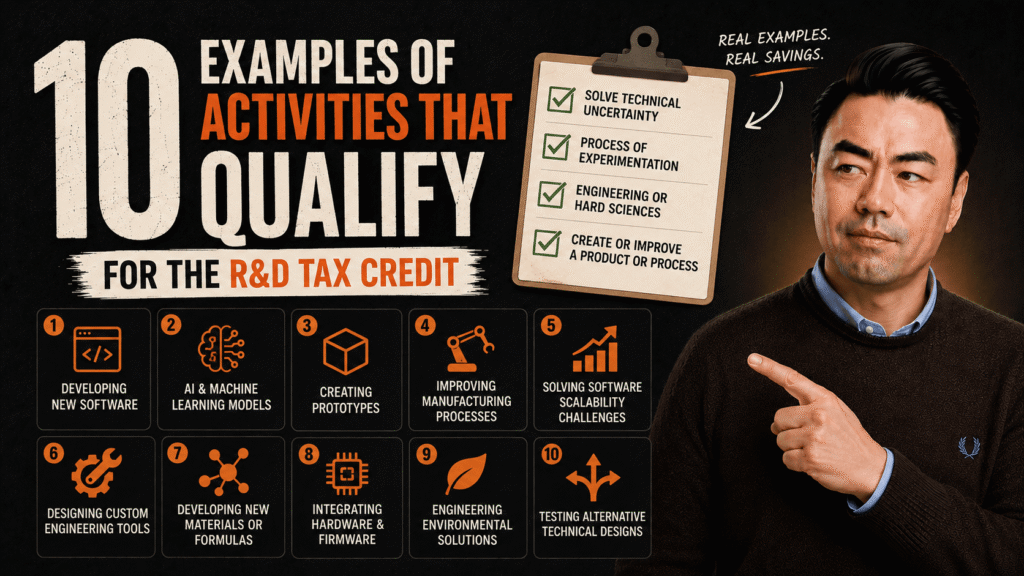
- 10 Examples Of Activities That Qualify
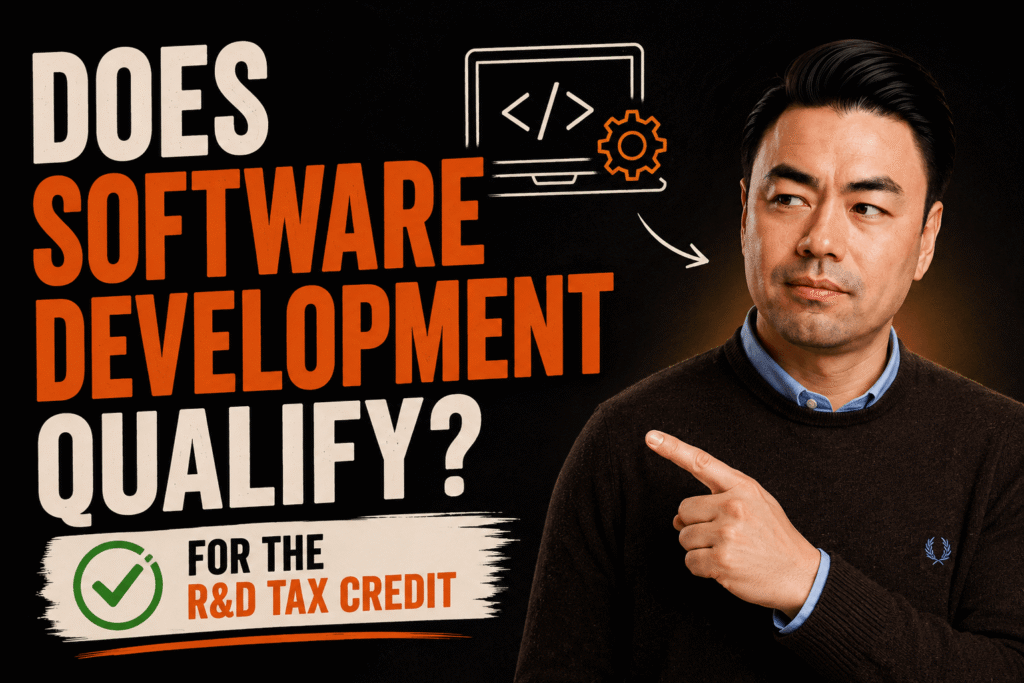
- Does Software Development Qualify?
You can also learn more about our Federal R&D Tax Credit Services, R&D Tax Credits For SaaS Companies, and Artificial Intelligence R&D Tax Credits to see how these rules apply across different industries.
[…] R&D Qualification Checklist […]
[…] R&D Qualification Checklist to quickly evaluate your current projects. […]
[…] reading: Learn how to apply these rules in practice with our R&D Qualification Checklist, then explore 10 Examples Of Activities That Qualify to see how real startup projects fit within […]
Comments are closed.