
Most yearly age startups do not miss the Federal R&D Tax Credit because they fail to comply with IRS rules. They miss it because they misunderstood how the Internal Revenue Code Section 41 four-part test applies to everyday engineering work.
We learned this lesson the hard way. Early on, we believed that writing code automatically meant we qualified for the federal research and development tax credit. Later, we discovered that the IRS doesn’t reward effort. It rewards proper documented technical experimentation because they only believe in proofs .
If your yearly stage startup is developing software, AI models, manufacturing processes, or engineering solutions, understanding the four-part test is the first step toward claiming valuable R&D tax credits with confidence.
Related reading: Before reviewing the IRS requirements, read What Qualifies For The R&D Tax Credit? to understand which activities and expenses are generally eligible. Then explore our Federal R&D Tax Credit, R&D Tax Credits for SaaS Companies, and Artificial Intelligence R&D Tax Credits service pages for industry-specific guidance.
What Is The IRS Four Part Test?
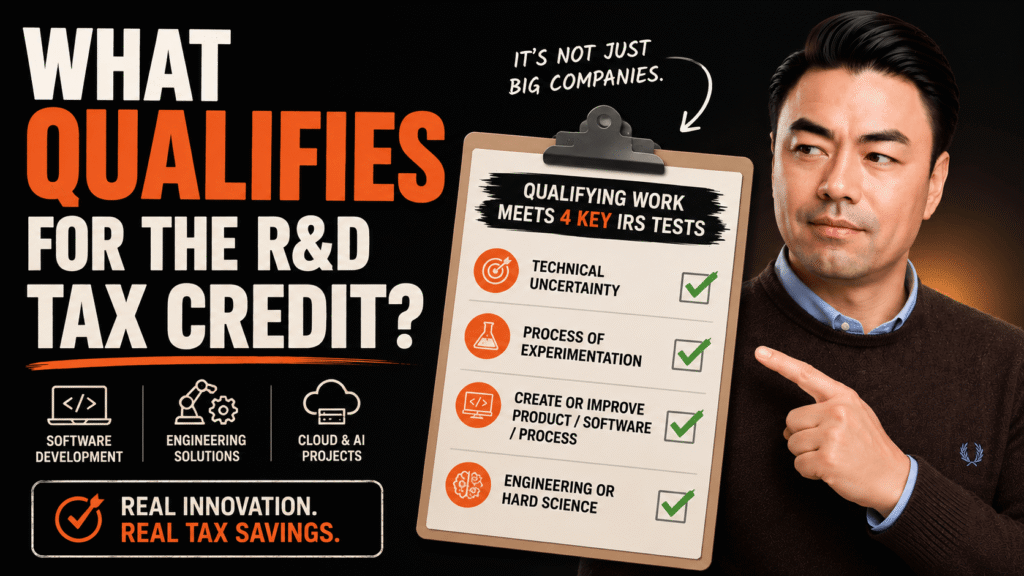
The IRS Four-Part Test determines whether your development work qualifies for the federal R&D tax credit under Internal Revenue Code Section 41. Every project must satisfy all four requirements.
Think of the test as a qualification framework rather than a checklist. Missing just one requirement can disqualify an otherwise impressive engineering project.
At R&D Tax Advisors, we organize every project through our Qualification Mapping Framework, which evaluates technical work against each IRS requirement before calculating Qualified Research Expenses. This helps reduce surprises during tax preparation.
1. Permitted Purpose
Your project must aim to create or improve a product, software application, manufacturing process, formula, or internal business component. The improvement must target functionality, reliability, quality, or performance.
Many founders confuse product updates with qualifying research. They are not always the same.
We learned this firsthand after investing months redesigning our application’s interface. Our developers wrote thousands of lines of code, yet most of the work focused on visual improvements and customer preferences.
The IRS Audit Techniques Guide makes an important distinction. Cosmetic redesigns, branding updates, and seasonal feature changes generally do not qualify because they improve appearance rather than technical capability.
A qualifying example would be rebuilding a payment engine to reduce transaction failures or redesigning a database architecture to improve processing speed under heavy user loads.
This is why our Innovation Intent Framework begins by identifying the technical objective before reviewing engineering hours.
2. Technological In Nature
Qualified research must rely on engineering or hard sciences such as computer science, physics, biology, chemistry, or engineering principles.
Business strategy, marketing, and creative design are valuable activities, but they are not qualifying research.
Imagine two software teams.
One team develops a recommendation engine using machine learning algorithms.
The other changes colors, typography, and homepage layouts based on customer feedback.
Only the first project primarily relies on computer science to solve technical challenges.
For startups developing SaaS platforms or AI products, this requirement is often satisfied naturally because the work depends on software engineering rather than creative design.
Through our Technical Evidence Framework, we separate engineering work from commercial activities before preparing any R&D claim.
3. Elimination Of Uncertainty
Your project must begin with genuine technical uncertainty. At the start, your team should not know whether the solution is technically possible or how to achieve it.
This uncertainty relates to capability, methodology, or system design.
It does not relate to funding.
It does not relate to customer demand.
It does not relate to project deadlines.
For instance an AI startup wants to reduce inference latency below 50 milliseconds while maintaining prediction accuracy. The engineering team knows the goal but does not know which architecture will achieve it. This innovation involve a lots of testing of different permutation and combination before reaching to any final results and
That uncertainty is exactly what the IRS wants to see.
Our Technical Uncertainty Matrix documents these unknowns before development begins, creating stronger support if the claim is later reviewed.
4. Process Of Experimentation
Your team must systematically evaluate different technical approaches before arriving at a solution. Failed experiments often strengthen an R&D claim rather than weaken it.
Experimentation means more than debugging code.
It includes testing multiple architectures, building prototypes, benchmarking performance, modeling alternatives, and validating different technical approaches.
One startup may compare three database structures before selecting one capable of supporting millions of API requests. Another may abandon an entire prototype after performance testing reveals scalability limitations.
Both examples demonstrate genuine experimentation.
Our Evidence Trail Framework connects Jira tickets, Git commits, architecture documents, testing results, and engineering discussions to each phase of experimentation, creating a defensible audit trail.
The Biggest Mistake We Made
We learned a painful lesson after investing heavily in what we believed was qualifying research.
Our developers spent months rebuilding our software platform. We confidently assumed the project satisfied every IRS requirement because it involved custom code and long development hours.
But we were wrong.
Because Most of our work focused on interface improvements driven by customer feedback instead of solving technical uncertainty. Although the project demanded significant effort, it failed the permitted purpose and technological requirements because the changes were primarily cosmetic rather than engineering breakthroughs.
That experience completely changed how we evaluate R&D projects today.
Final Thoughts
The IRS Four-Part Test is not designed to demotivate and exclude innovative startups. It is designed to differentiate between genuine technical research and routine business activities.
When startup founders truly understand these IRS four requirements before development begins, they can easily structure their projects, documentation, and engineering records in a way that supports a stronger Federal Research Credit claim while reducing any type of compliance risk.
If your company or startups develops software, AI platforms, engineering solutions, or new products, reviewing your projects through the lens of IRS Four-Part Test is very important before filing. It can serve as the difference between a successful claim and unclaimed valuable tax credits.
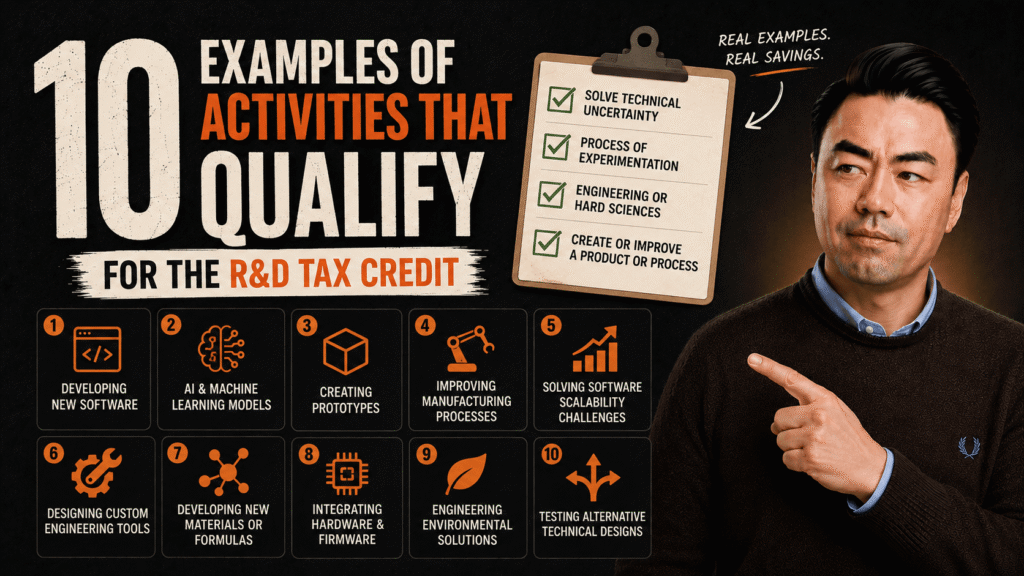
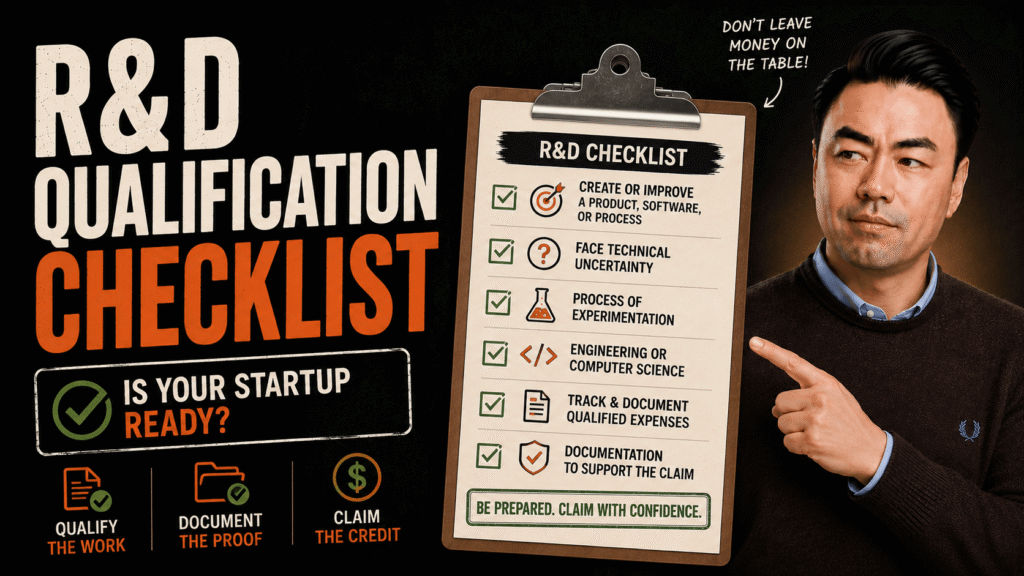
Continue reading: Learn how to apply these rules in practice with our R&D Qualification Checklist, then explore 10 Examples Of Activities That Qualify to see how real startup projects fit within Internal Revenue Code Section 41.
[…] Our guide on The Four Part IRS Test Explained examines each qualification requirement in […]
[…] , start with our What Is The R&D Tax Credit? guide to understand the fundamentals. Then review The Four Part IRS Test Explained before using this Free checklist that I have created to evaluate your […]
[…] The Four Part IRS Test Explained […]
[…] you’re new to the credit, begin with What Qualifies For The R&D Tax Credit? and The Four Part IRS Test Explained before Evaluating your software […]
Comments are closed.