
Many founders assume that Federal R&D Tax Credit is for breakthrough inventions or billion dollar technology companies. That misconception costs several startups millions every year.
Your business may qualify if you are solving technical uncertainty through experimentation to create or improve a product, software, process, or technology. Under Internal Revenue Code Section 41, the IRS focuses on how your team solves technical problems, irrespective of whether the project becomes a commercial success or not .
At R&D Tax Advisors, we have found that yearly stage startups rarely miss the credit because they lack innovation. They miss it because they lack the understanding of what actually qualifies for credits.
Related: If you’re new to the credit, start with What Is The R&D Tax Credit? before learning how qualification works.
The IRS Uses Four Requirements To Determine Qualification
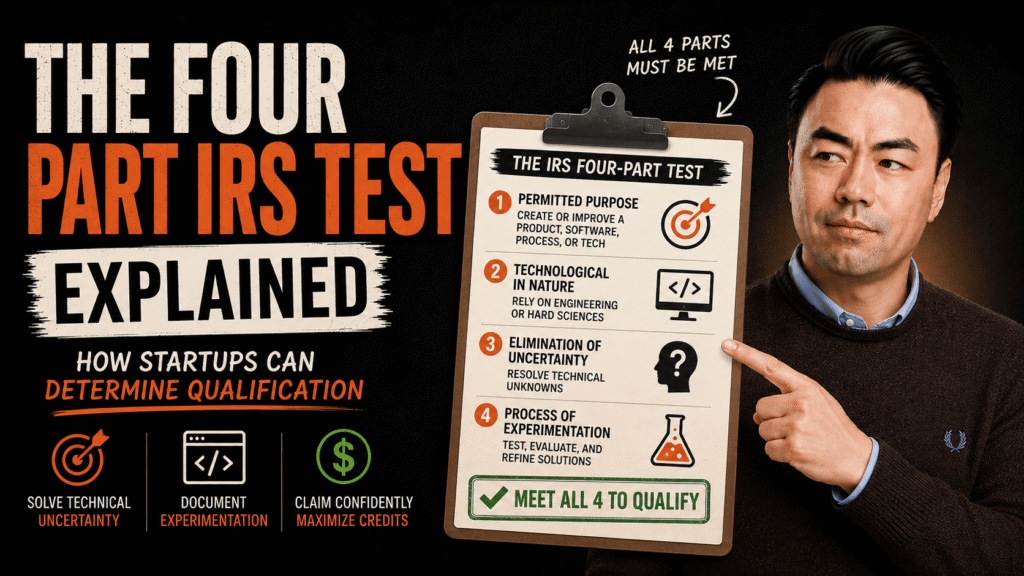
Every activity must satisfy the IRS Four-Part Test to qualify for the Federal Research and Development Tax Credit. Missing just one requirement can disqualify an otherwise innovative project.
Your work generally qualifies when it:
- Seeks to create or improve a product, software, process, technique, or formula.
- Attempts to eliminate technical uncertainty.
- Uses a process of experimentation to evaluate possible solutions.
- Relies on engineering, computer science, physics, biology, chemistry, or another hard science.
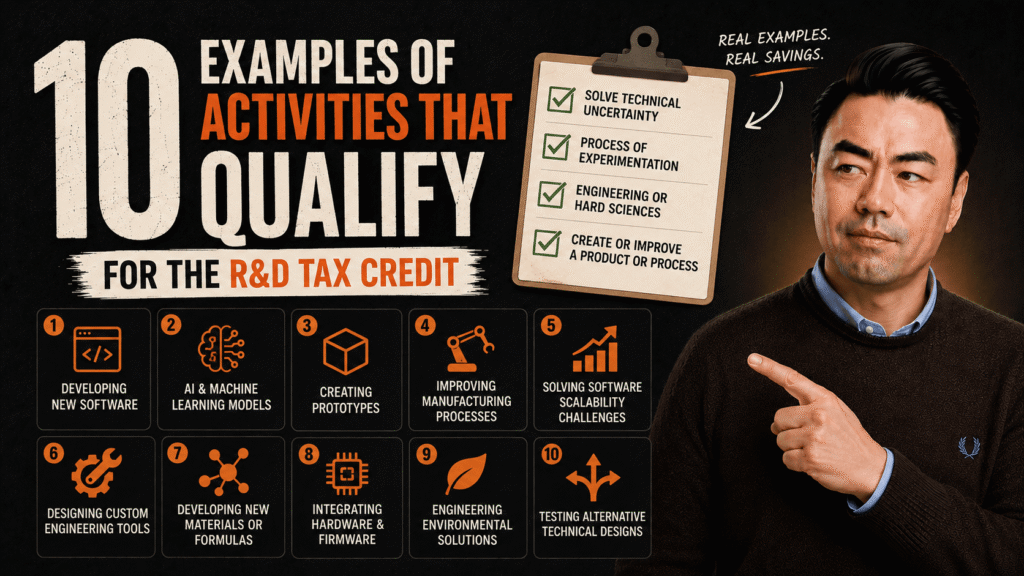
For example, imagine a SaaS startup building an AI-powered fraud detection platform. The engineering team doesn’t know whether a new machine learning architecture can accurately detect fraudulent transactions while maintaining acceptable response times. They test multiple models, measure performance, abandon unsuccessful approaches, and eventually identify a working solution.
That development process is far more important than whether the first version succeeds.
This is why we developed our Qualification Confidence Framework, which evaluates projects against IRS requirements before tax calculations even begin.
Next: Our guide on The Four Part IRS Test Explained examines each qualification requirement in detail.
Qualified Research Expenses Matter Just As Much As Qualified Activities
Qualifying work alone does not generate the credit. The related expenses must also qualify.
The IRS generally allows businesses to include several categories of Qualified Research Expenses (QREs), including:
- W-2 wages for employees performing, supervising, or supporting qualified research
- Supplies consumed during testing or prototype development
- A qualifying portion of payments made to domestic contractors
- Cloud computing costs directly related to software development and testing
Many startup founders only track engineering salaries while overlooking contractor costs or development cloud infrastructure.
We learned how expensive that mistake can become. Early in our experience reviewing startup claims, we saw companies spending heavily on cloud environments and domestic engineering contractors without realizing those expenses could contribute to their Federal R&D Tax Credit calculation.
Our Qualified Expense Mapping Framework helps founders identify eligible costs before valuable credits are overlooked.
What Most Industry Guides Completely Ignore Is The Exclusion Trap
Qualifying research can still become a nonqualifying claim if it falls into one of the IRS exclusions.
This is where many startups lose significant tax savings.
We have seen fast-growing software companies outsource core engineering to overseas development teams while simultaneously customizing their platform for individual enterprise customers. The technical work involved genuine experimentation, difficult engineering problems, and extensive testing.
Yet much of it failed to qualify.
Research performed outside the United States generally does not qualify for the Federal Research Credit. Likewise, adapting an existing product to meet one customer’s specific requirements may also be excluded, even when the engineering work is technically challenging.
The painful lesson is simple.
Innovation alone is not enough.
Your operational structure must also align with IRS qualification rules.
That is why our Eligibility Boundary Framework reviews not only technical activities but also where the work occurs, who performs it, and whether customer contracts could affect eligibility before a claim is prepared.
Activities That Usually Do Not Qualify
Not every technical project qualifies for the R&D Tax Credit.
Common exclusions include:
- Research performed outside the United States
- Customizing an existing product for one specific customer
- Routine quality control testing
- Market research
- Consumer preference studies
- Research in the social sciences, arts, or humanities
Understanding these exclusions helps startups avoid overclaiming while strengthening the defensibility of legitimate research activities.
Build Qualification Before You Build Your Claim
The strongest R&D Tax Credit claims begin with correctly identifying qualifying activities, not calculating credits.
Founders should first determine several factors such as :
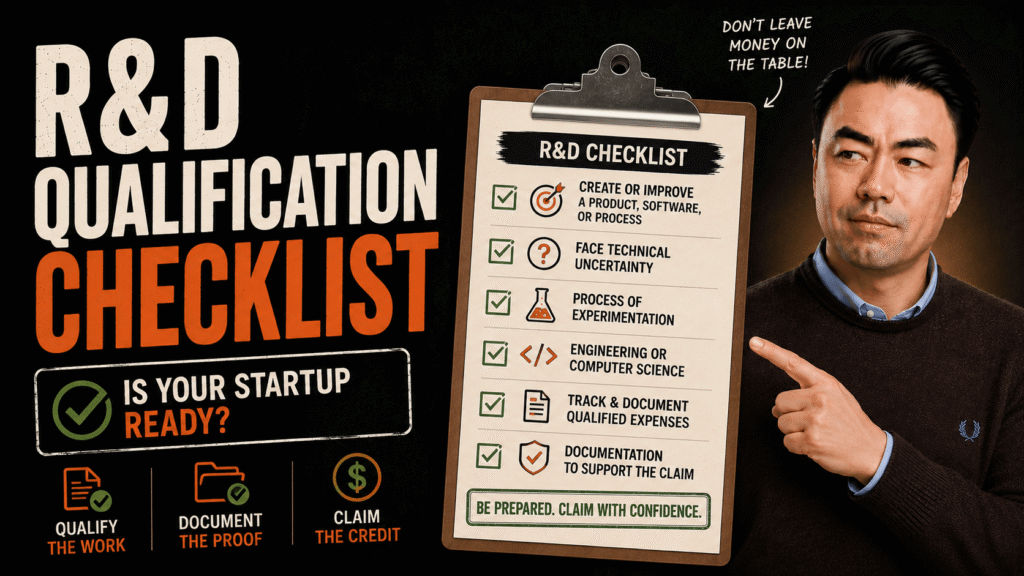
- Does the project involve technical uncertainty?
- Was experimentation required in this ?
- Was the work performed within the United States?
- Are qualified expenses properly documented or not ?
- Does the activity satisfy every part of the IRS qualification test?
Answering these questions early creates a stronger claim and reduces future compliance risk.
Continue building your qualification knowledge:
- The Four Part IRS Test Explained for a detailed breakdown of every IRS requirement.
- R&D Qualification Checklist to quickly evaluate your current projects.
- 10 Examples Of Activities That Qualify to see how startups across different industries claim the credit.
- Does Software Development Qualify? to understand how software, SaaS, and AI companies fit within Internal Revenue Code Section 41.
At R&D Tax Advisors, we truly believe qualification should never be based on your assumptions. Our approach is to build every claim with documented technical evidence, giving founders confidence before a return is ever filed.

[…] reading: Before reviewing the IRS requirements, read What Qualifies For The R&D Tax Credit? to understand which activities and expenses are generally eligible. Then explore our Federal […]
[…] What Qualifies For The R&D Tax Credit? […]
[…] you’re new to the credit, begin with What Qualifies For The R&D Tax Credit? and The Four Part IRS Test Explained before Evaluating your software […]
Comments are closed.